
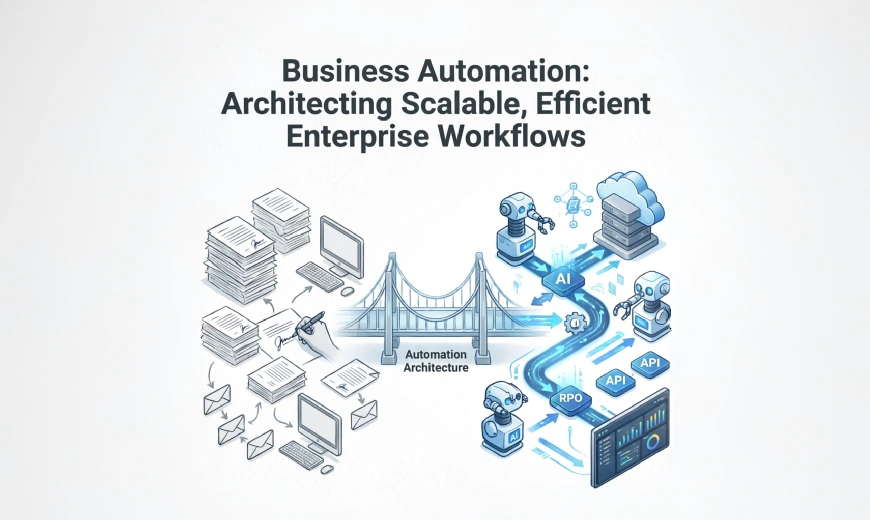
Business Automation: Architecting Scalable, Efficient Enterprise Workflows
Introduction
When enterprise processes are engineered to operate with precision, speed, and minimal human intervention, this drives business automation - a strategic capability reshaping how modern organizations operate and scale.
Instead of relying on fragmented, manual workflows, organizations are now designing intelligent, interconnected systems that streamline operations and deliver consistent outcomes. Business automation is no longer just about efficiency - it's about building a foundation for agility, scalability, and data-driven decision-making.
Enterprises that embrace this shift are not only improving productivity but also positioning themselves to respond faster to change and drive sustained growth in an increasingly dynamic market.
What is Business Automation?
Business automation refers to the use of technology to execute tasks and processes with minimal human involvement. At an enterprise level, it goes beyond automating individual tasks and focuses on integrating and optimizing entire workflows.
It involves technologies such as:
- Robotic Process Automation (RPA) for repetitive tasks
- Artificial Intelligence (AI) and Machine Learning (ML) for decision-making
- Business Process Management (BPM) for designing and controlling workflows
The goal is to create a system where processes are standardized, traceable, and optimized for performance.
Why Companies Need Better Workflow Automation
1. Improved Efficiency
Manual processes are time-consuming, error-prone, and inconsistent. Automation improves speed and accuracy.
2. Scalable Growth
As companies grow, processes become more complex. Automation enables scaling without significantly increasing resources.
3. Better Decision-Making
Automated workflows generate data and insights, helping organizations make informed decisions.
4. Cost Reduction
Automation reduces errors and manual effort, leading to significant cost savings.
5. Compliance and Governance
Standardized workflows help organizations follow regulations and reduce risks.
Core Components of Enterprise Workflow Automation
Process Discovery and Mapping
Analyzing workflows to identify inefficiencies and automation opportunities.
Workflow Design and Standardization
Defining clear rules and structures so processes operate consistently across the organization.
System Integration
Ensuring all enterprise systems are connected and work seamlessly together.
Automation Technologies
- RPA for task automation
- AI/ML for intelligent decision-making
- BPM for workflow orchestration
Continuous Improvement
Monitoring workflow performance to identify issues and optimize processes over time.
Steps to Build Better Enterprise Workflows
Step 1: Identify Key Processes
Focus on processes that are repetitive, time-consuming, and prone to errors—such as billing, onboarding, and reporting.
Step 2: Define Clear Objectives
Ensure automation aligns with business goals and delivers measurable improvements.
Step 3: Choose the Right Technology
Select tools that integrate well with existing systems and support scalability.
Step 4: Design Flexible Workflows
Create workflows that can adapt to changing business needs.
Step 5: Establish Governance
Implement controls to ensure workflows are secure, compliant, and well-managed.
Step 6: Test and Optimize
Test workflows before deployment and continuously improve them based on performance data.
Best Practices for Business Automation
1. Start Small and Scale
Begin with high-impact use cases and expand gradually.
2. Focus on User Experience
Ensure workflows are easy to use and encourage adoption.
3. Enable Collaboration
Automation should help teams work together and share data efficiently.
4. Maintain Data Quality
Accurate and reliable data is essential for effective automation.
5. Support Workforce Transition
Train employees to adapt and work effectively with automated systems.
Common Challenges in Workflow Automation
1. Legacy Systems
Older systems may not integrate easily with modern automation tools.
2. Lack of Standardization
Unstructured processes can limit automation effectiveness.
3. Over-Automation
Automating unnecessary processes can increase complexity.
4. Skill Gaps
A lack of expertise can slow down implementation and optimization.
Future of Business Automation
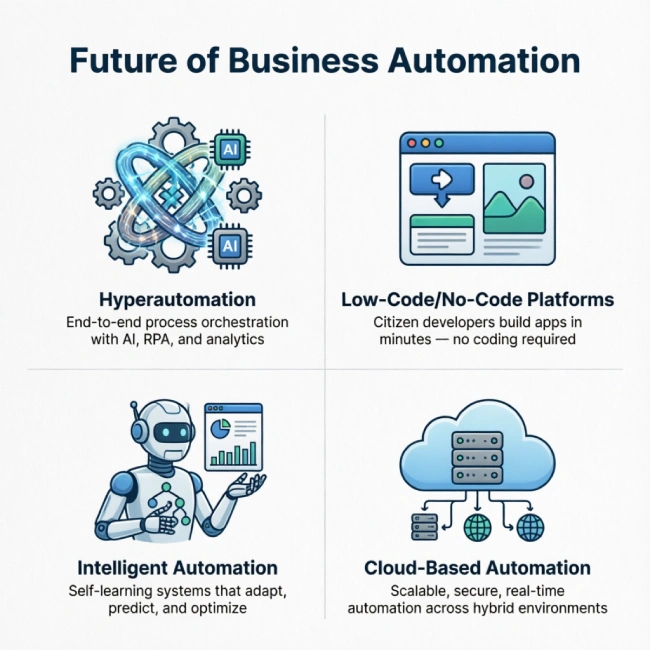
1. Hyperautomation
Combining multiple technologies to automate complex processes end-to-end.
2. Low-Code/No-Code Platforms
Allowing non-technical users to design and deploy workflows.
3. Intelligent Automation
AI-driven systems that learn, adapt, and make decisions.
4. Cloud-Based Automation
Providing scalable and flexible automation solutions.
Measuring Automation Success
Key performance indicators include:
Tracking these metrics helps organizations continuously improve efficiency.
Conclusion
Business automation is essential for organizations aiming to improve efficiency and achieve scalable growth. By optimizing workflows, companies can enhance productivity, make better decisions, and remain competitive.
The focus should be on building scalable, resilient workflow systems that align with business goals. Organizations that adopt this approach will be better equipped to handle change, grow effectively, and stay ahead in the market.
Evaluate your enterprise workflows and identify automation opportunities that drive efficiency and scalability.
Learn more at https://www.talentsmart.co.in/


