
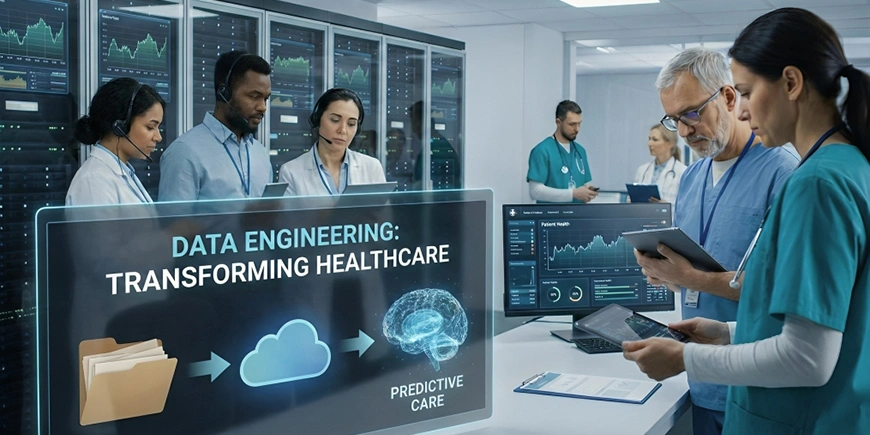
How Data Engineering is Transforming Healthcare
From Patient Records to Predictive Care
Healthcare is experiencing one of the most dramatic digital shifts of our time, and at the heart of that transformation lies data engineering. From digitizing patient records to powering predictive care models, data engineering has become the backbone of modern healthcare innovation. It is enabling hospitals, clinics, research centers, and digital health platforms to work smarter, diagnose earlier, personalize treatment, and deliver more efficient patient care.
In this blog, we explore how data engineering is reshaping the healthcare ecosystem, why it matters, and what the future holds.
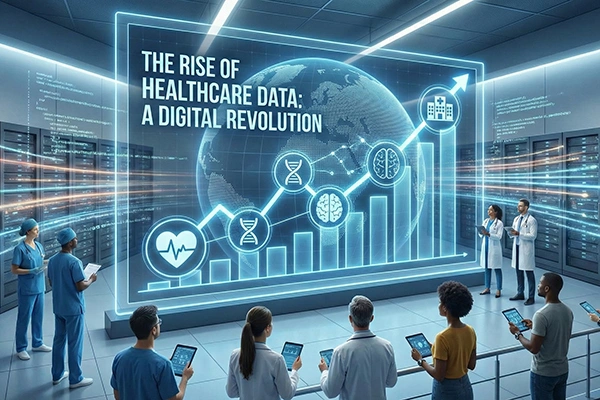
The Rise of Healthcare Data: A Digital Revolution
Over the last decade, the volume of healthcare data has exploded. Electronic Health Records (EHRs), wearable devices, imaging scanners, hospital management systems, genomics data, and telemedicine interactions have collectively created a massive, complex data ecosystem.
But raw data alone cannot transform healthcare. It is data engineering — the structured process of collecting, cleaning, transforming, and organizing data — that converts this messy information into usable insights.
Healthcare organizations now rely on scalable data pipelines, cloud platforms, and advanced integration frameworks to unify their data sources. This shift has laid the foundation for smarter, data-driven decisions at every level of care.
From Paper Files to Connected Health Systems
For decades, medical information lived inside filing cabinets, handwritten prescriptions, and standalone systems that couldn't talk to each other. Data engineering changed this picture entirely.
Through robust data ingestion pipelines, interoperability frameworks, and secure storage architectures, organizations can now:
- Integrate EHRs from multiple facilities
- Combine clinical, lab, and pharmacy data
- Connect patient wearables with real-time monitoring systems
- Standardize formats using HL7, FHIR, and DICOM
- Build a unified patient profile for every individual
The result is a connected ecosystem where doctors, administrators, and care coordinators can access the right data at the right time — no more fragmented or duplicated records.
How Data Engineering Improves Patient Care
Data engineering impacts patient care in several meaningful ways. Some of the most transformative benefits include:
-
Faster and More Accurate Diagnoses
Clean, structured, real-time data enables doctors to diagnose conditions more accurately. Lab results, medical images, previous history, and wearable data can be consolidated into a single, accessible view. With this, clinicians can identify health patterns that were previously invisible.
-
Personalized Treatment Plans
Data pipelines that process patient demographics, genetics, lifestyle data, and clinical history help in developing precision medicine models. Personalized treatments are no longer "nice to have" — they're becoming essential for chronic disease management, oncology care, and mental health.
-
Reduced Medical Errors
Medication errors, duplicate tests, and miscommunication are significant challenges in traditional healthcare systems. With accurate, normalized datasets, data engineering reduces human errors and improves care coordination across departments.
-
Real-Time Monitoring and Alerts
Wearables, smart sensors, and remote monitoring devices constantly push live data into healthcare systems. Data pipelines allow healthcare providers to track vital signs in real time. This makes it possible to alert clinicians before a patient's condition worsens.
-
Efficient Hospital Operations
Data engineering isn't just about clinical care — it supports operational excellence. Hospitals can optimize staffing, reduce wait times, manage bed availability, and streamline emergency workflows using reliable data-driven insights.
The Shift Toward Predictive and Preventive Care
One of the biggest advantages of modern data engineering is its ability to feed AI and predictive analytics models. Predictive care is becoming a game changer.
Using continuous data pipelines and advanced data modeling, healthcare providers can:
- Predict patient readmission risks
- Identify early signs of disease progression
- Forecast ICU requirements
- Detect anomalies in imaging scans
- Anticipate medicine shortages
- Prevent potential outbreaks
Predictive care moves healthcare from reactive to proactive, ultimately improving patient outcomes and reducing costs across the board.

Behind the Scenes
Data Engineering Technologies Driving the Change
Several technologies and frameworks make modern healthcare data engineering possible:
Cloud Platforms
Healthcare is rapidly migrating to cloud infrastructures like GCP, AWS, and Azure. They provide scalable storage, automated pipelines, secure access controls, and compliance-ready architecture.
Big Data Tools
Platforms such as Apache Spark, Hadoop, and Kafka help organizations handle massive datasets in batch and real time.
Data Integration & ETL Tools
Fivetran, Talend, Informatica, and cloud-native ETL frameworks streamline data ingestion and transformation.
Interoperability Standards
FHIR, HL7, and DICOM ensure that data flows smoothly across systems.
AI-Ready Data Pipelines
ML pipelines allow anonymized, structured data to fuel machine learning models without compromising privacy.
Security and Compliance: The Non-Negotiable Pillars
Healthcare data is sensitive — and protecting it is not optional. Data engineers must build systems that are:
HIPAA-compliant
GDPR-ready
Fully encrypted
Access-controlled
Audited and monitored
Built with patient privacy at the center
Modern data engineering emphasizes secure data lakes, tokenization, masking, and role-based access to ensure patient information is protected at every stage.
The Future: Intelligent Healthcare Ecosystems
The transformation we're seeing today is only the beginning. As data engineering continues to evolve, healthcare will move toward fully intelligent ecosystems where:
AI assists doctors in diagnosis
Patients receive reminders tailored to their medical history
Hospitals run digitally with automated workflows
Robots assist in surgeries using real-time data
Genomic data shapes personalized therapies
Preventive care becomes the new norm
The future of healthcare is smart, connected, predictive, and patient-centric — driven entirely by robust data engineering.
Conclusion
Data engineering has quietly become the engine powering the healthcare revolution. From digitizing patient records to enabling predictive care, it ensures that data flows seamlessly, securely, and intelligently across the healthcare ecosystem. As organizations deepen their investments in cloud infrastructure, AI readiness, and advanced data integration, the next decade will bring unprecedented advancements in patient care, disease prevention, and healthcare operations.
Healthcare's future belongs to those who treat data as a strategic asset — and data engineering is the key to unlocking that potential.
Ready to Transform Healthcare with Data Engineering?
Learn how modern data pipelines and AI-ready architectures are shaping the future of patient care.
Explore Our Solutions

