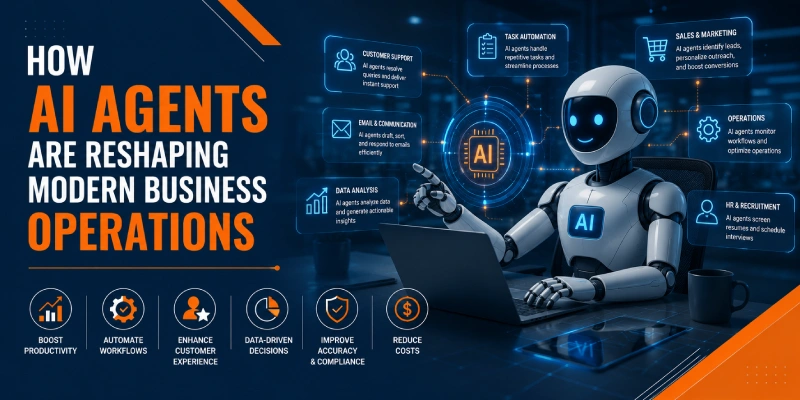
How AI Agents Are Reshaping
Modern Business Operations
Discover how AI agents transform business operations with real-world use cases, automation strategies, and implementation insights.
Introduction
The Next Inflection Point in Business Efficiency
Businesses have always pursued one goal: doing more with less. From assembly lines to ERP systems, every technological era has redefined what 'operational efficiency' means. Today, we stand at the next inflection point - the era of AI agents in business operations.
Unlike traditional automation that executes fixed scripts, AI agents perceive their environment, reason through complex tasks, make decisions, and take actions - often without a human in the loop.
KEY INSIGHT
AI agents differ fundamentally from traditional bots or RPA tools. They combine large language models (LLMs), memory, planning capabilities, and tool-use to handle open-ended, multi-step tasks in dynamic environments.

Architecture
What Exactly Are AI Agents?
An AI agent is a software entity powered by a large language model (LLM) that is given a goal and autonomously determines the steps to achieve it. It can browse the web, write and execute code, query databases, send emails, call APIs, and coordinate with other agents.
The Anatomy of an AI Agent
Perception
Reads inputs - text, files, APIs, databases, sensor data
Reasoning Engine (LLM)
Plans, deduces, and decides the next action
Memory (Short & Long Term)
Stores context, past interactions, and learned preferences
Action Layer (Tools)
Executes tasks - browse, code, write, communicate
Feedback Loop
Evaluates outcomes and adjusts strategy iteratively
Business Transformation
How AI Agents Are Transforming Business Operations
The impact of AI agents spans virtually every business function. Here are the most significant areas of transformation for modern enterprises.
IT Operations & AIOps
AI agents are becoming the backbone of AIOps - continuously monitoring infrastructure, detecting anomalies, correlating events across systems, and auto-remediating incidents. They parse thousands of log lines in seconds and identify root causes that would take human analysts hours.
Limitations of Traditional Automation
Why Traditional Automation Falls Short
Rule-based automation (RPA, static workflows) breaks when conditions change - a renamed field, a new exception, an unexpected input format. Maintaining these systems becomes a growing technical debt problem.
| ❌ Traditional Automation | ✅ AI Agent Approach |
|---|---|
| • Follows fixed rules only | ✓ Adapts to new conditions dynamically |
| • Breaks on exceptions | ✓ Handles ambiguity through reasoning |
| • Requires structured data | ✓ Processes structured & unstructured data |
| • Single-task execution | ✓ Multi-step, goal-oriented task completion |
| • Needs constant maintenance | ✓ Self-corrects and improves over time |
| • Siloed per system | ✓ Orchestrates across multiple tools & APIs |
Implementation Framework
A Practical 5-Phase Implementation Framework
Adopting AI agents does not require a complete infrastructure overhaul. The following five-phase framework gives IT professionals a structured path to implementation.
Phase 1: Identify High-Impact Use Cases
Start with repetitive, data-heavy processes with well-defined success metrics. ITSM, data ingestion pipelines, and reporting workflows are ideal starting points.
Phase 2: Choose the Right Architecture
Decide between single-agent, multi-agent, and human-in-the-loop models. Supervised agents reduce risk for critical processes.
Phase 3: Integrate with Existing Systems
Ensure your chosen platform supports API integration with ITSM, CRM, ERP, and monitoring tools. REST APIs, webhooks, and MCP are emerging standards.
Phase 4: Establish Governance & Guardrails
Define what agents can do autonomously vs. what requires approval. Implement logging, audit trails, RBAC, and align with ISO 27001, SOC 2, and GDPR.
Phase 5: Monitor, Evaluate & Scale
Deploy with observability from day one. Track completion rates, error rates, escalation frequency, and KPIs to refine and scale successful agents.
Challenges & Mitigation
Key Challenges and How to Navigate Them
AI agents introduce new categories of risk that IT professionals must proactively address:
| Challenge | Mitigation Strategy |
|---|---|
| Hallucination & incorrect outputs | Implement output validation; use human-in-the-loop for high-stakes tasks |
| Data privacy & security | Use on-premise or private-cloud LLMs for sensitive workloads |
| Prompt injection attacks | Harden input sanitization; use sandboxed execution environments |
| Unpredictable agent behavior | Define clear action boundaries and test with simulation environments |
| Integration complexity | Use standardized API contracts and agent orchestration platforms |
| Regulatory compliance | Maintain full audit logs; consult legal team on AI Act and GDPR obligations |
Platforms & Ecosystem
Real-World Platforms to Get Started
For IT teams ready to move from evaluation to implementation, the LLM agents and autonomous AI systems ecosystem has matured considerably.
EVALUATION TIP
Prioritize platforms with built-in audit logging, RBAC, and private deployment options - especially for regulated industries. Starting with a managed platform reduces operational overhead and accelerates time to value.