10 Best Practices for Building Scalable Applications in 2026
Discover 10 proven best practices for building scalable applications in 2026 - from microservices to observability - and future-proof your software.
Modern applications rarely fail quietly. The cracks show up the moment a marketing campaign goes viral, a product launches in a new region, or a seasonal spike hits checkout flows at the worst possible time. The cost is never just downtime - it is lost revenue, eroded trust, and engineering teams stuck firefighting instead of building.
Building scalable applications in 2026 takes more than provisioning bigger servers. It requires a deliberate approach across architecture, infrastructure, data, automation, and team culture. This guide breaks down ten proven application scalability best practices, along with a simple problem-to-solution framework you can apply to your own systems today.
The goal isn't a system that survives growth. It's one that grows without anyone noticing the strain.
Why Scalability Can't Be an Afterthought
Cloud cost models, AI-driven traffic patterns, and globally distributed users have changed what "scale" actually means.
The ten practices below are the ones experienced engineering teams return to again and again, regardless of the stack, industry, or company size involved.

Modern scalable architecture requires intentional design across every layer of the stack
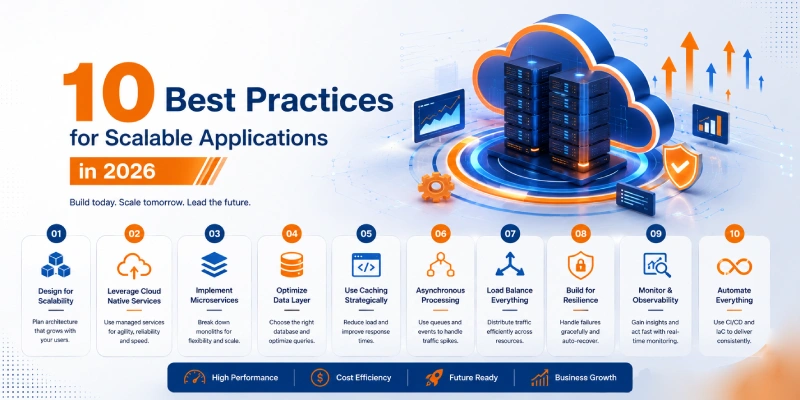
The 10 Best Practices for Building Scalable Applications
Each of these practices addresses a specific scalability bottleneck. Together, they form a repeatable framework: identify the constraint, apply the right pattern, and validate it under real load.
Design with Microservices Architecture from Day One
Monolithic applications scale as a single unit, which means every component grows - or fails - together. A microservices architecture breaks the system into independently deployable services, so teams can scale the components under the most pressure, such as checkout or search, without over-provisioning everything else.
Embrace Cloud-Native and Containerized Infrastructure
Containerization with Docker and orchestration with Kubernetes have become the default foundation for scalable system design. Containers package an application with its dependencies, making it portable across environments, while orchestration platforms automate scaling, scheduling, and self-healing across clusters.
Implement Horizontal Scaling Over Vertical Scaling
Vertical scaling - adding more CPU or memory to a single server - has hard physical and cost limits. Horizontal scaling, where additional instances are added behind a load balancer, offers near-linear capacity growth and far better fault tolerance, since no single node becomes a point of failure.
Use Asynchronous Processing and Event-Driven Design
Synchronous request chains create bottlenecks the moment one dependency slows down. Message queues and event-driven pipelines decouple producers from consumers, letting heavy or non-urgent tasks - emails, report generation, image processing - run independently without blocking the user-facing path.
Optimize Database Architecture for Growth
Databases are usually the first component to hit a scalability ceiling. Sharding, read replicas, and choosing the right database model - relational versus NoSQL - for each workload prevent a single data store from becoming a bottleneck as transaction volume and data size increase.
Build a Robust Caching Strategy
Caching is one of the highest-leverage scalability levers available. Storing frequently accessed data in-memory with tools like Redis or a CDN reduces database load, cuts response times, and absorbs sudden traffic spikes without scaling the underlying infrastructure.
Automate with CI/CD and Infrastructure as Code
Manual deployments do not scale alongside growing infrastructure. CI/CD pipelines paired with Infrastructure as Code tools such as Terraform let teams provision, test, and deploy environments consistently, reducing human error and shortening the time between an idea and production.
Monitor, Observe, and Set Up Proactive Alerts
You cannot scale what you cannot see. Observability - metrics, logs, and distributed tracing combined - gives engineering teams the visibility to catch bottlenecks before users do. Proactive alerting turns a potential outage into a routine fix.
Design for Failure with Resilience Patterns
At scale, failures are inevitable, not exceptional. Resilience patterns such as circuit breakers, retries with backoff, and graceful degradation contain failures to a small blast radius instead of letting them cascade across the entire application.
Prioritize Security and Compliance at Scale
As systems scale, so does their attack surface. Security and compliance must be embedded into the architecture itself - zero-trust networking, encryption in transit and at rest, and automated compliance checks - rather than bolted on after growth has already happened.
Scale the bottleneck, not the whole system - targeted fixes beat blanket infrastructure upgrades every time.
Quick Framework: From Problem to Scalable Solution
Use this at-a-glance mapping to diagnose the bottleneck you are facing and the corresponding practice to apply.
| Symptom / Problem | Recommended Practice | |
|---|---|---|
| Single component slows down the whole app | Microservices architecture | |
| Servers maxed out during traffic spikes | Horizontal scaling + auto-scaling | |
| Background tasks block user requests | Async, event-driven processing | |
| Database queries slow as data grows | Sharding, replicas, caching | |
| Deployments are slow and error-prone | CI/CD + Infrastructure as Code | |
| Outages discovered only after users complain | Observability + proactive alerting |
Common Scalability Mistakes to Avoid
These anti-patterns trip up even experienced teams. Recognize them early to stay on track.
- Treating scalability as a one-time infrastructure upgrade instead of an ongoing architectural discipline.
- Scaling every component equally instead of identifying and targeting the actual bottleneck.
- Skipping load testing until after a real-world traffic spike exposes the gap.
- Ignoring cost-efficiency, leading to scalable but financially unsustainable systems.
Frequently Asked Questions
Clear answers to the most common questions about building scalable applications.
A. Performance measures how fast a system responds under current conditions, while scalability measures how well that performance holds up as load, data, or users increase significantly.
A. No. Smaller applications often perform well as a well-structured monolith. Microservices add the most value when specific components face independent, unpredictable scaling demands.
A. Rising response times, increasing error rates under load, and resource utilization consistently near capacity are early indicators that scaling action is needed.
A. Caching typically delivers the fastest return, since it reduces database load and improves response times without requiring major architectural changes.
A. No. Growing startups and mid-sized products benefit just as much, since early scalability planning prevents expensive re-architecture later.
Ready to build a scalable application architecture for your growing business?
Let our engineering team help you design, build, and scale your application the right way from day one.
Contact Us