12 Best APIs for Developers to Explore in 2026
Discover the 12 best APIs for developers in 2026 — AI, payments, communication, and more — plus a practical framework for choosing one.
Every application built today leans on a growing stack of external APIs — for intelligence, payments, communication, identity, and data. The problem is rarely a shortage of options; over 500 AI APIs alone are now available, before payments, messaging, and infrastructure APIs are even counted. The real challenge is narrowing that field to the handful of services that genuinely fit a project's requirements, budget, and scale.
This guide shortlists twelve APIs that consistently stand out across AI, payments, communication, location, identity, and data categories in 2026, followed by a practical framework for evaluating any API before it becomes a dependency.
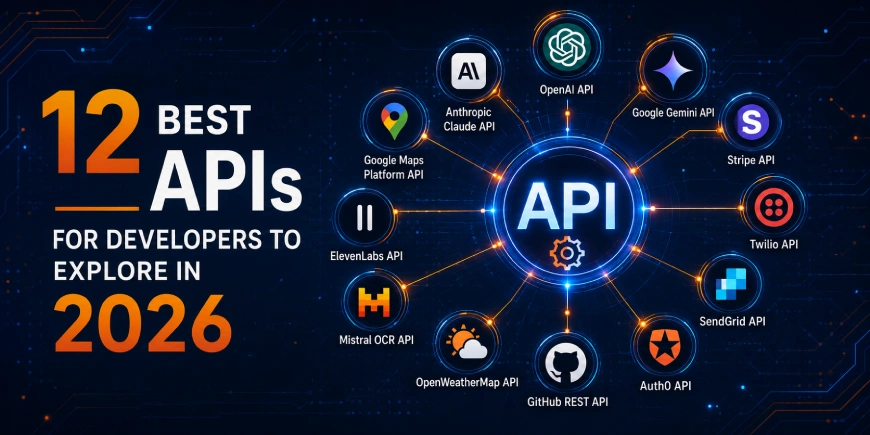
The best APIs for developers in 2026 span eight categories — AI (OpenAI, Anthropic Claude, Google Gemini), payments (Stripe), communication (Twilio, SendGrid), location (Google Maps Platform), identity (Auth0), automation (GitHub REST API), utility data (OpenWeatherMap), and document/voice AI (Mistral OCR, ElevenLabs)
How to Evaluate the Best APIs for Your Needs
An API is not just a technical integration — it becomes a long-term dependency that affects reliability, cost, and how easily an application scales. Choosing based on hype rather than fit tends to surface later as unpredictable billing, rate-limit ceilings, or a migration project nobody budgeted for.
Key note: In 2026, most production applications rely on five to ten different APIs, each handling a distinct function. Treating API selection as an architectural decision — not an afterthought — pays off well before an application reaches scale.
The 12 Best APIs for Developers in 2026
OpenAI API
The OpenAI API remains a default starting point for chat assistants, content tools, and agentic workflows. The GPT-5 model family handles text, code, and image reasoning through a single endpoint, with function calling that simplifies integration into existing applications — especially when paired with an AI coding assistant during development.
Anthropic Claude API
Claude's API is a strong choice for coding, document analysis, and instruction-heavy workflows, supported by a large context window that processes extensive codebases or reports in a single call. Its emphasis on predictable, safety-conscious behaviour suits regulated or safety-critical use cases — the same reliability that makes it a strong fit for agentic AI workflows in production.
Google Gemini API
Gemini 2.5 Pro combines a million-token context window with one of the most accessible free tiers among frontier models, making it a practical entry point for prototyping before committing to paid infrastructure.
Mistral OCR API
Mistral's OCR API extracts text, tables, and structure from scanned documents and PDFs at competitive per-page pricing. It fits naturally alongside a language model API when a pipeline needs to turn unstructured documents into usable data.
ElevenLabs API
ElevenLabs provides high-fidelity text-to-speech, voice cloning, and dubbing across multiple languages, positioning it as a leading choice for voice-first products. Low-latency streaming support makes it viable for real-time voice agents rather than pre-recorded audio alone.
Stripe API
Stripe sets the benchmark for payment API design, with clear documentation, predictable error handling, and support for subscriptions, invoicing, and global currencies. Its webhook system reduces the engineering overhead typically tied to billing logic.
Twilio API
Twilio provides programmable SMS, voice, WhatsApp, and verification services through a consistent API surface. It remains the reference point for adding two-factor authentication, appointment reminders, or conversational messaging to an application.
SendGrid API
SendGrid, part of Twilio's communications stack, focuses on reliable delivery of transactional email such as receipts, password resets, and account alerts, with built-in analytics for open and bounce rates.
Google Maps Platform API
Google Maps Platform bundles geocoding, directions, and places search into a single set of APIs that power most location-aware applications in production today. Accurate global coverage makes it difficult to substitute for logistics or travel use cases.
Auth0 API
Auth0 remains the enterprise-grade standard for authentication, offering single sign-on, multi-factor authentication, and social login without requiring identity infrastructure to be built from scratch. Its compliance certifications matter most once an application handles sensitive user data.
GitHub REST API
The GitHub REST API exposes repositories, issues, pull requests, and actions programmatically, making it central to internal tooling, bots, and CI/CD automation. Comprehensive endpoint coverage makes it one of the more approachable APIs to learn.
OpenWeatherMap API
OpenWeatherMap supplies current conditions, forecasts, and historical weather data through a straightforward REST interface, with a free tier generous enough for prototyping and small-scale production use.
Quick Comparison Overview
| # | API | Category | Primary Function | Best For |
|---|---|---|---|---|
| 01 | OpenAI API | AI | Language & multimodal generation | Conversational products, multimodal reasoning |
| 02 | Anthropic Claude API | AI | Long-context reasoning & coding | Code generation, instruction-following |
| 03 | Google Gemini API | AI | Multimodal AI with free tier | Prototyping, cost-sensitive AI features |
| 04 | Stripe API | Payments | Payments & billing infrastructure | E-commerce, SaaS subscription billing |
| 05 | Twilio API | Communication | SMS, voice, WhatsApp messaging | OTP verification, chat commerce |
| 06 | Google Maps Platform | Infrastructure | Location, routing, places data | Delivery tracking, location context |
| 07 | SendGrid API | Communication | Transactional email delivery | Account notifications, inbox placement |
| 08 | Auth0 API | Infrastructure | Authentication & identity | Enterprise identity management |
| 09 | GitHub REST API | Infrastructure | Repository automation | Release automation, CI/CD tooling |
| 10 | OpenWeatherMap API | Infrastructure | Weather & environmental data | Trip planning, weather-aware features |
| 11 | Mistral OCR API | AI | Document parsing & OCR | Invoice processing, PDF to data |
| 12 | ElevenLabs API | AI | Voice synthesis & dubbing | Voice assistants, multilingual content |
A Practical Framework for Choosing an API
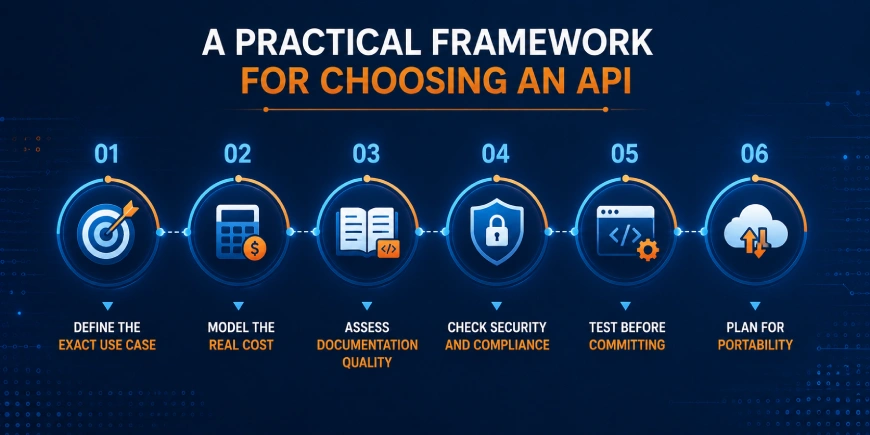
With comparable options available in almost every category, selection should follow a repeatable process rather than a one-off decision.
Define the exact use case
Start with a narrow, well-defined problem before comparing providers, rather than choosing a platform first and retrofitting a use case to it.
Model the real cost
Evaluate pricing and rate limits, and check whether they scale linearly with expected usage.
Assess documentation quality
Read the documentation before writing any code — clear references, working code samples, and an interactive console are strong signals of ongoing product investment.
Check security and compliance
Confirm compliance certifications, data residency options, and audit logging for any API that touches user or payment data.
Test before committing
Build a small proof of concept against the free tier or sandbox environment before committing to a contract or production rollout.
Plan for portability
Favour providers that support standard formats such as OpenAPI, since switching costs stay lower when integrations follow common conventions.
Bringing It Together
The strongest technology stacks in 2026 are rarely built on a single dominant API. They combine a small number of well-chosen services — one for intelligence, one for payments, one for communication — each selected for a specific, well-understood reason. Auditing an existing stack against the framework above is often the fastest way to spot redundant integrations, exposed cost risk, or a vendor that has quietly become a single point of failure.
Teams evaluating a broader integration strategy — or facing the classic build vs. buy decision on whether to build this in-house — often benefit from an outside review of the architecture before development begins with our application development services.
Frequently Asked Questions
An API, or application programming interface, is a defined set of rules that allows one piece of software to request data or functionality from another. It lets a development team add capabilities such as payments, messaging, or AI reasoning without building that infrastructure independently.
Many free tiers suit prototyping and low-volume features, but typically come with rate limits, reduced support, and no uptime guarantees. A paid or enterprise tier is generally safer once core functionality depends on the API.
The decision usually comes down to the specific task rather than a single best option — accuracy and context length matter most for reasoning and coding, while cost and latency matter more for high-volume features. Testing candidates against representative sample data beats comparing marketing claims.
Pricing structure, rate limits, documentation quality, security certifications, and data handling policies all warrant review before integration begins. A short proof-of-concept against the sandbox environment usually surfaces issues documentation alone does not.
Yes. Providers regularly update versions, deprecate endpoints, and revise pricing, so integrations need periodic review rather than a one-time setup.
For more insights on software development, technology trends, and digital solutions
Visit TalentSmart Soft Solutions