IT & Software Development Company | IT Staffing Services | Talent Smart

ISO 27001 / ISMS Certified
ARTIFICIAL INTELLIGENCE

AI in Cybersecurity:How Artificial Intelligence Is Redefining Modern Cyber Defense

ai_in_cybersecurity

Share :

Cybersecurity Insights

AI in Cybersecurity: How Artificial Intelligence Is Redefining Modern Cyber Defense

Discover how AI in cybersecurity helps organizations detect threats faster, automate incident response, reduce alert fatigue, and strengthen modern cyber defense.

12 Min Read
2026
AI Security

Cyberattacks no longer announce themselves with a single suspicious email or an obvious malware signature. Today's threats are automated, adaptive, and capable of probing thousands of endpoints before a human analyst even opens their dashboard. This shift is precisely why AI in cybersecurity has moved from an emerging concept to an operational necessity. Artificial intelligence is now reshaping how organizations detect, analyze, and respond to threats — often before damage occurs.

This article breaks down why traditional cyber defense is struggling to keep pace, how artificial intelligence in cyber defense is closing that gap, and a practical framework you can use to evaluate and implement AI-driven security tools.

The Cybersecurity Problem: Why Human-Led Defense Alone No Longer Works

Security operations centers are drowning in alerts. Analysts are expected to triage thousands of notifications daily, distinguishing genuine intrusions from noise — a task that grows harder as attack surfaces expand across cloud, hybrid, and remote environments. Three structural problems make manual defense increasingly unsustainable:

Alert Fatigue

Security teams often ignore or delay investigation of alerts simply because there are too many to review manually.

Talent Shortage

Skilled cybersecurity professionals remain in short supply globally, leaving teams understaffed relative to threat volume.

Attack Speed

Modern attacks, including ransomware and automated credential-stuffing bots, execute in minutes — faster than most manual response workflows can react.

Key Takeaway: This is the environment in which machine learning cybersecurity solutions have become essential rather than optional. AI doesn't replace the security analyst — it removes the noise so the analyst can focus on what actually matters.

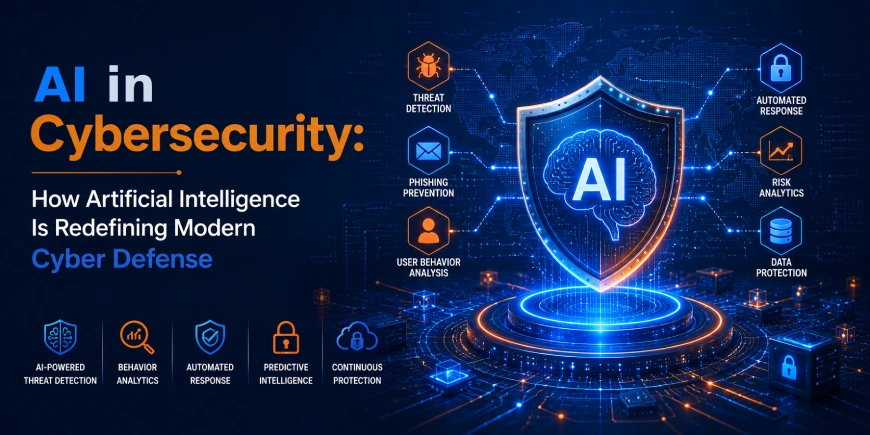
AI detecting cyber threats in real-time across network endpoints

How Artificial Intelligence Is Redefining Cyber Defense

AI-powered security tools apply pattern recognition, statistical modeling, and behavioral analysis at a scale no human team could replicate. Here's where the impact is most significant.

01

Real-Time Threat Detection Through Machine Learning

Instead of relying solely on known malware signatures, machine learning models are trained on massive datasets of both legitimate and malicious activity. This allows AI threat detection systems to flag suspicious behavior — such as unusual data transfers or abnormal login patterns — even when the specific attack method has never been seen before.

02

Behavioral Analytics and Anomaly Detection

User and Entity Behavior Analytics (UEBA) tools build a baseline of "normal" behavior for every user, device, and application. When activity deviates from that baseline — a login from an unusual location, a spike in file access — the system raises a flag automatically, often catching insider threats and compromised credentials that signature-based tools miss entirely.

03

AI-Powered Automated Incident Response

Beyond detection, AI enables automated incident response — isolating a compromised endpoint, revoking access tokens, or blocking a malicious IP address within seconds of detection. This dramatically shortens the window between compromise and containment, which is often the single biggest factor in limiting breach damage.

04

Predictive Threat Intelligence

By analyzing global threat data, dark web chatter, and emerging vulnerability disclosures, AI systems can forecast which attack vectors are likely to target a specific industry or infrastructure next. This predictive threat intelligence allows security teams to patch and prepare proactively rather than reactively.

05

Smarter Phishing and Social Engineering Detection

Natural language processing models now analyze email content, sender behavior, and linguistic patterns to catch phishing attempts that bypass traditional spam filters — including sophisticated, AI-generated phishing emails designed to mimic legitimate communication.

06

Intelligent Vulnerability Management

Rather than presenting security teams with an overwhelming list of vulnerabilities, AI-driven vulnerability management tools prioritize patches based on exploitability, asset criticality, and real-world attacker activity — helping teams fix what matters most, first.

Traditional Security vs. AI-Driven Security

Capability Traditional Security Tools AI-Driven Security Tools
Detection Speed Hours to Days Seconds to Minutes
Threat Coverage Known Signatures Only Known + Zero-Day Patterns
Response Model Manual, Analyst-Dependent Automated + Human Oversight
Scalability Limited by Headcount Scales with Data & Compute
Adaptability Static Rule Updates Continuous Learning
Key Insight

AI in cybersecurity is not about removing humans from the loop — it's about giving human analysts the speed, context, and prioritization needed to act decisively. The strongest security postures combine AI-driven automation with experienced human judgment.

A Practical Framework for Implementing AI in Cyber Defense

Adopting AI-powered security tools works best as a structured process rather than a single tool purchase. The following four-step framework offers a practical starting point.

1

Assess Your Current Threat Landscape

Map existing tools, data sources, and gaps. Identify where alert volume, response time, or blind spots are creating the most risk.

Tool Audit Data Mapping Gap Analysis Risk Prioritization
2

Integrate AI Where Data Already Exists

Start with AI-enhanced detection layered onto existing SIEM, endpoint, or network monitoring tools rather than replacing infrastructure outright.

SIEM Enhancement Endpoint Layering Network Monitoring Minimal Disruption
3

Automate Low-Risk, High-Volume Responses

Let AI handle repetitive triage and containment actions — such as isolating flagged endpoints — while escalating high-stakes decisions to analysts.

Auto Triage Endpoint Isolation Human Escalation Risk-Based Rules
4

Monitor, Retrain, and Refine Continuously

AI models degrade without fresh data. Schedule regular retraining and validation cycles to keep detection accuracy aligned with evolving threats.

Model Retraining Accuracy Validation Threat Alignment Continuous Feedback

Challenges to Consider Before Adopting AI Security Tools

AI adoption in cybersecurity isn't without friction. A balanced strategy accounts for the following:

Adversarial AI

Attackers are increasingly using AI themselves to craft evasive malware and convincing phishing content, creating an ongoing arms race.

False Positives and Negatives

Poorly tuned models can still generate noise or, worse, miss genuine threats — model tuning and validation are essential.

Data Privacy and Compliance

AI systems require large volumes of behavioral data, which must be handled in line with data protection regulations.

Over-Reliance on Automation

Full automation without human oversight can lead to blind spots when AI encounters genuinely novel attack patterns.
The Future of AI-Driven Cybersecurity

The next phase of this evolution points toward autonomous security operations centers, where generative AI assists in drafting incident reports, simulating attack scenarios, and even recommending remediation code. As these capabilities mature, the organizations that build strong AI-augmented security foundations today will be far better positioned to withstand the next generation of cyber threats.

Automated Reports
Attack Simulation
Remediation Code
Autonomous SOC

Frequently Asked Questions

What is AI in cybersecurity?
AI in cybersecurity refers to the use of machine learning, natural language processing, and behavioral analytics to detect, predict, and respond to cyber threats faster and more accurately than traditional rule-based systems.
How does AI improve threat detection?
AI improves threat detection by analyzing massive volumes of data in real time, identifying patterns and anomalies that indicate malicious activity — including previously unseen (zero-day) attack methods.
Can AI completely replace human cybersecurity professionals?
No. AI is most effective as a force multiplier, handling high-volume detection and triage so human analysts can focus on complex investigations, strategic decisions, and incident response oversight.
What are the risks of relying on AI security tools?
Key risks include false positives or negatives from poorly tuned models, adversarial AI attacks designed to evade detection, and data privacy concerns tied to the large datasets AI systems require.
Is AI-driven cybersecurity practical for small and mid-sized organizations?
Yes. Many AI-powered security tools are now available as cloud-based, subscription services, making enterprise-grade threat detection accessible without large upfront infrastructure investment.
How should an organization start implementing AI in its security strategy?
Start by assessing existing gaps, layering AI detection onto current tools, automating low-risk responses, and establishing a continuous monitoring and retraining cycle — as outlined in the four-step framework above.

Ready to Strengthen Your Cyber Defense Strategy?

Explore how AI-powered security solutions can help your organization detect threats faster and respond smarter.

Reach Us

Leave a comment

Your email address will not be published. Required fields are marked *

GET IN TOUCH

Ready to Get Started?