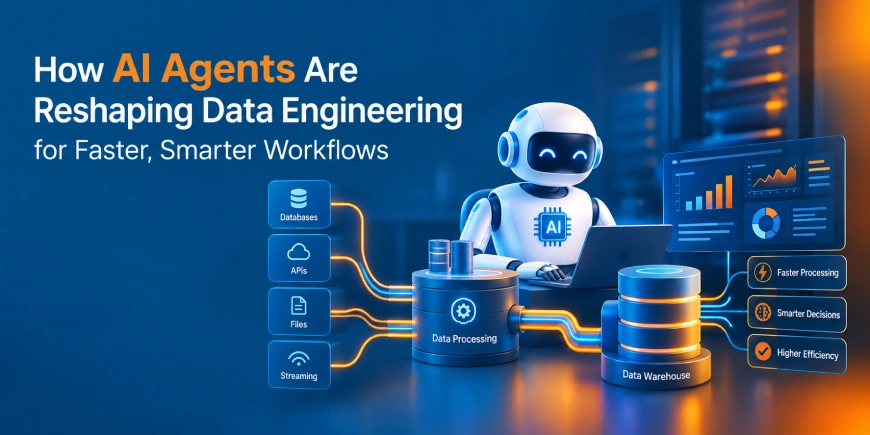
How AI Agents Are Reshaping Data Engineering for Faster, Smarter Workflows
The shift from AI assistance to agentic data engineering
Data engineering has always involved more than moving data from one system to another. Teams must understand schemas, transform raw data, orchestrate jobs, enforce quality rules, monitor failures, document lineage, and keep pipelines reliable as source systems change. As data environments grow, a large share of engineering time can be consumed by repetitive maintenance and troubleshooting rather than higher-value architecture and optimization work.
AI agents are beginning to change that operating model. Instead of acting only as coding assistants, agents can plan multi-step tasks, inspect metadata, generate or modify pipeline code, call tools, validate outputs, and respond to failures within defined guardrails — the same pattern already reshaping end-to-end business process automation across HR, finance, and IT operations. Google Cloud, IBM, and Databricks now document agentic capabilities for building, modifying, monitoring, and troubleshooting data pipelines, showing that this shift is moving from experimentation into practical data-platform workflows.
The real value of AI agents is not “autonomous data engineering without people.” It is faster execution of repeatable work, with engineers defining architecture, rules, quality thresholds, security controls, and approval points.
What are AI agents in data engineering?
In data engineering, an AI agent is a software system that can interpret a goal, break it into steps, use tools or APIs, observe results, and take the next action. A conventional generative AI assistant may suggest SQL or Python. An agentic workflow can go further by inspecting a schema, drafting transformations, validating code, executing a test, detecting an error, and proposing or applying a correction.
This is why the term agentic data engineering is useful: it describes the application of AI agents across the lifecycle of building and maintaining data systems, rather than using AI only for isolated code generation.
From assistant to agent: what changes?
| Workflow stage | Traditional approach | Agent-enabled approach |
|---|---|---|
| Pipeline creation | Engineer writes each step and configuration manually. | Agent drafts pipeline logic from intent, metadata, and instructions for review. |
| Data transformation | SQL/Python is written, tested, and revised manually. | Agent generates transformations, validates syntax, and iterates on errors. |
| Monitoring | Teams respond to alerts and investigate logs. | Agent can correlate metadata, run history, and errors to suggest root causes. |
| Maintenance | Schema or source changes trigger manual debugging. | Agent can detect drift, identify impacted steps, and propose controlled fixes. |
| Documentation | Lineage and operational notes are often updated separately. | Agent can assist with documentation and context capture as workflows change. |
Why data engineering is a strong fit for AI agents
Repeatable, tool-driven work
Modern data platforms contain many repeatable, tool-driven tasks: schema inspection, code generation, transformation testing, orchestration changes, data-quality checks, log analysis, and dependency tracing. These activities are well suited to an agent that can work across a defined set of tools while following explicit instructions.
Business-critical pipelines
At the same time, data pipelines are business-critical. A poorly generated transformation can silently corrupt downstream reporting, model features, or operational decisions. That makes data engineering a strong candidate for agentic automation—but only when validation, permissions, observability, and human review are designed into the workflow.
5 ways AI agents are reshaping data engineering workflows
Faster pipeline design and development
Agents can translate a natural-language goal into a proposed pipeline structure, identify relevant source tables, generate transformations, and organize code in the engineering workspace. Google Cloud’s Data Engineering Agent, for example, can build and modify BigQuery and Dataform pipelines using natural-language prompts. The practical benefit is shorter time from requirement to first working draft—not the elimination of engineering review.
Automated code validation and iterative fixes
Agentic workflows can validate generated code, detect compilation or execution failures, and retry with corrections. This closes part of the loop between “generate code” and “produce working code.” Databricks describes agent mode as capable of planning, retrieving relevant assets, running pipeline code, using outputs, and fixing errors during development.
Smarter monitoring and troubleshooting
When a pipeline fails, engineers often search logs, inspect recent schema changes, compare run history, and trace dependencies. An agent can bring those signals together and propose a likely root cause. This can reduce mean time to diagnosis, especially for recurring operational problems, while escalation rules keep high-risk fixes under human approval.
Continuous data quality support
Agents can help apply quality rules, detect anomalies, flag schema drift, and recommend remediation. The important distinction is that the agent should not invent the definition of “good data.” Teams still need explicit expectations for completeness, freshness, uniqueness, validity, and business-specific constraints.
More self-service without bypassing governance
An agentic interface can let analysts or domain teams express a data need in natural language and receive a governed dataset or proposed pipeline. This can reduce routine handoffs, but the safest implementations reuse approved data products, policies, catalogs, permissions, and templates rather than giving every user unrestricted pipeline-generation capabilities.
A practical framework for adopting agentic data engineering
The most effective way to introduce AI agents is to start with bounded workflows, measurable outcomes, and clear approval rules. A five-step approach keeps the implementation useful without turning experimentation into unmanaged automation.
Choose a narrow, repetitive workflow
Start with tasks such as pipeline scaffolding, SQL transformation generation, run-failure triage, documentation, or data-quality rule creation. Avoid beginning with autonomous production changes across critical datasets.
Ground the agent in trusted context
Give the agent access to the schemas, catalog, lineage, run history, coding standards, and business rules it actually needs. This trusted foundation should align with a well-defined data architecture strategy, whether organizations use centralized or domain-oriented approaches. Better context reduces guesswork and helps the agent produce environment-specific outputs.
Limit tools and permissions
Use least-privilege access. Separate read, test, deploy, and production permissions. An agent that can inspect production metadata does not automatically need permission to change production resources.
Validate before execution
Add automated tests for schema compatibility, row counts, data quality, security rules, and expected outputs. For high-impact changes, keep a human approval checkpoint before deployment.
Measure engineering outcomes
Track cycle time, failure rate, mean time to recovery, test coverage, escaped data-quality incidents, rework, and engineer time saved. The goal is reliable productivity—not simply more generated code.
The operating model:
A reliable agentic data workflow should look less like an unrestricted chatbot and more like a controlled engineering system. This approach aligns closely with intelligent workflow orchestration, where AI-driven workflows coordinate tasks, tools, data, and execution within defined controls. The agent receives an intent, retrieves approved context, uses only permitted tools, executes in a safe environment, validates the result, and then either stops, retries, or requests approval.
Where AI agents can go wrong
Agentic automation introduces new failure modes alongside its productivity benefits. Teams should plan for them before production adoption.
Incorrect but plausible output
Generated code can be syntactically valid while implementing the wrong business logic. Tests and dataset-level validation remain essential.
Excessive permissions
An agent with broad write access can turn a small reasoning error into a large operational incident. Apply least privilege and scoped credentials.
Weak metadata or documentation
Agents perform poorly when table meaning, ownership, lineage, and quality expectations are unclear. Improving metadata often improves agent performance.
Silent propagation of data errors
Automating a bad transformation only makes the error move faster. Quality gates should exist before data reaches downstream consumers.
Loss of accountability
Every agent action should be observable. Capture prompts or instructions, tool calls, code changes, approvals, run results, and rollback information where appropriate.
Will AI agents replace data engineers?
The more realistic near-term change is a shift in what engineers spend time on. Agents can absorb portions of repetitive implementation and support work, while engineers remain responsible for architecture, data contracts, security, platform standards, performance, cost, governance, and business correctness.
That changes the skill mix. The ability to define strong instructions, design reusable platform guardrails, evaluate generated changes, build tests, and manage trusted metadata becomes more valuable. In other words, the engineer moves further toward system design and control while the agent handles more of the mechanical execution.
What a production-ready agentic data workflow should include
- Clear task boundaries and ownership
- Trusted catalog, schema, lineage, and business context
- Least-privilege tool access
- Development or sandbox execution by default
- Automated code and data-quality tests
- Approval gates for high-impact changes
- Observability for agent actions and pipeline outcomes
- Rollback and recovery procedures
- Security, privacy, and compliance controls
- KPIs that measure reliability and engineering productivity
Frequently asked questions
What are AI agents in data engineering?
AI agents in data engineering are systems that can plan and perform multi-step data tasks using tools, APIs, metadata, and code. They can assist with pipeline creation, transformations, testing, monitoring, troubleshooting, and maintenance within defined controls.
How are AI agents different from generative AI coding assistants?
A coding assistant typically responds to a prompt with code or an explanation. An AI agent can continue across multiple steps: gather context, choose a tool, execute an action, inspect the result, and decide what to do next.
Can AI agents build data pipelines automatically?
Yes, current platforms can generate or modify pipelines from natural-language instructions. However, production use should include code review, automated validation, permissions, data-quality checks, and approval rules.
What are the biggest benefits of AI agents for data teams?
The main benefits are faster development, reduced repetitive work, quicker troubleshooting, more consistent automation, and greater engineering capacity for architecture and optimization.
What are the risks of agentic data engineering?
Key risks include incorrect business logic, over-permissioned agents, weak data context, silent quality failures, security exposure, and insufficient observability. Guardrails and testing are essential.
Do AI agents eliminate the need for data engineers?
No. They change how work is divided. Engineers still own system design, governance, security, data quality, performance, platform reliability, and the business correctness of production data.
The next phase of data engineering is agent-assisted, governed, and measurable
AI agents are moving data engineering from isolated code assistance toward multi-step workflow automation. Their strongest value appears in repetitive, tool-driven work: drafting pipelines, generating transformations, validating code, investigating failures, and supporting quality operations. But speed alone is not the goal. The winning model combines agentic execution with trusted context, controlled permissions, automated validation, observability, and human accountability.
Teams that start with bounded use cases and strong engineering guardrails can gain productivity without sacrificing reliability. Over time, that creates a data platform that is not only faster to operate, but better prepared for the growing demands of analytics, AI applications, and real-time decision-making.