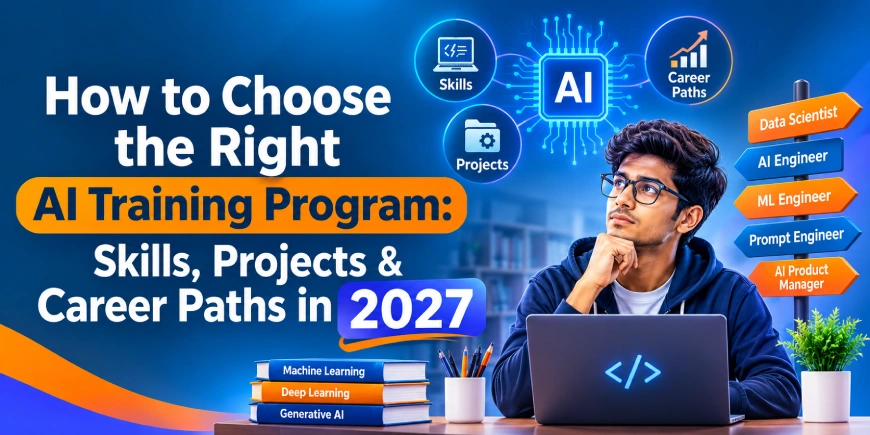
How to Choose the Right AI Training Program: Skills, Projects & Career Paths in 2027
A few years ago, learning AI meant a postgraduate course in statistics. Today, a marketer drafting campaign ideas, an HR manager summarising documents and a student building a first chatbot are all working with AI tools. That is why choosing an AI training program has become a real decision for people far beyond software teams.
The hard part is the number of options: short certificates, weekend workshops, university courses, bootcamps and free platform courses, all promising to make you “AI-ready”. You will see how to match training to your goal, which skills matter for which role, how to judge any course before paying for it, and how to follow a realistic roadmap for 2027. In short, choose training that matches your goal, fits your current level and has you build real projects.
Why AI Upskilling Matters in 2027
AI tools are now part of everyday work in many fields: writing and summarising, data analysis, customer support, software development, design and operations. Generative AI, meaning systems that create text, images, code or audio from a written instruction, has made these abilities available to people who have never written a line of code.
That opens different doors for different people. Students can stand out by showing practical project work. Professionals can hand routine tasks to AI and spend more time on judgement. Non-technical learners can understand where AI genuinely helps and where it does not.
Understanding limits matters just as much. AI systems can give confident but wrong answers, reflect bias from their training data, and mishandle sensitive information. Good AI upskilling therefore covers capabilities, limitations and responsible use together. We will not predict job outcomes; AI literacy simply looks useful across roles while tools keep changing.
Understand Your Career Goals Before Choosing an AI Training Program
Two people can take the same course and get very different value from it. Start with your own situation.
Students & Recent Graduates
Aim for fundamentals plus visible proof. A good goal is to learn Python basics, understand how machine learning works, and finish two or three projects you can show.
Working Professionals
Focus on your current job. For example, an analyst might learn to use AI tools for faster reporting, while a developer might learn to build applications on top of large language models.
Non-IT Professionals
You do not need to become a programmer. Learning to use generative AI tools well, check their output and protect sensitive data is a strong and realistic goal. Once you are comfortable with the basics, a practical next step is to build a simple AI-powered app without code that automates one task in your own work.
Career Changers
Pick one target role, then work backwards. Build foundations first, then a small portfolio that shows how your earlier experience combines with new AI skills.
Experienced Tech Professionals
Look for depth: AI agents, evaluation methods, deployment and governance. Skip beginner content you already know.
Business Owners & Managers
Your goal is informed decision-making: spotting good use cases, understanding risks, and asking vendors the right questions. Hands-on tool practice helps, but deep coding usually does not. If you are weighing whether to develop AI in-house or adopt ready-made tools, see our guide on build vs buy AI decisions.
 AI upskilling now spans students, professionals, managers and career changers —
each with a different starting point.
Which AI Skills Should You Learn?
Use this as a guide, not a checklist. Focus on the skills most relevant to you.
How to Evaluate an AI Training Program
Use this checklist to evaluate any AI training program, regardless of where it comes from.
| Criterion | What to Check |
|---|---|
| Curriculum relevance | Does it cover current tools and methods, and is there a visible update date? |
| Instructor experience | Can you see what the trainers have actually built or delivered? |
| Beginner prerequisites | Does the course state clearly what you must know beforehand? |
| Hands-on learning | Is a meaningful share of the time spent practising, not watching? |
| Real-world projects | Will you finish with work you can explain in an interview? |
| Tools & technologies | Are they relevant to the roles you want? |
| Support & feedback | Do you get reviews of your work and a way to ask questions? |
| Duration & schedule | Does the time commitment fit your life? |
| Fees & value for money | Is everything included, and is pricing transparent? |
| Certificates | Is the certificate recognised by employers, or is it only a completion document? |
| Career guidance | If placement support is offered, is it described honestly, without guarantees? |
How to verify quality before enrolling
- Ask for the full syllabus and a sample lesson or demo session.
- Request examples of past learner projects.
- Search for independent learner feedback, not only testimonials on the provider’s own site.
- Finally, ask the questions below.
Ask the provider
- Who will teach this, and what have they built in real projects?
- How many hours are live practice versus recorded content?
- What will I be able to do on the last day that I cannot do today?
- How recently was the content updated?
- What exactly does “career support” include, and what does it not include?
Why Hands-On AI Projects Matter
Theory tells you how something works. A project shows you can make it work. That is why AI training with hands-on projects deserves priority. When you build, you meet messy data, unclear instructions and unexpected AI errors, and those are the problems real jobs contain.
Document Q&A Assistant
A tool that answers questions using only your own files, such as policy documents.
AI Research Assistant
A workflow that collects sources on a topic and drafts a structured summary for human review.
Business Task Automation
Automatically sorting incoming emails, drafting replies or preparing weekly reports.
Data Analysis with AI Tools
Exploring a public dataset and explaining the findings in plain language.
A Simple AI Chatbot
Answering common questions for a small business, with clear limits on what it can say.
Projects also work as evidence. A short write-up explaining the problem, your approach, what went wrong and what you would improve tells an employer far more than a certificate title does.
Choosing the Right AI Learning Path for Your Background
Use the table below as a starting point, then adjust for your own goals and time.
| Background | Start With | Useful Skills | Example Project |
|---|---|---|---|
| Students & Graduates | AI fundamentals, then Python basics and a guided ML course | Python, data handling, ML basics, portfolio on GitHub | Predict an outcome from a public dataset and publish a short write-up |
| Non-Technical Professionals | Generative AI and prompting fundamentals | Prompting, AI productivity tools, privacy awareness | Build a prompt library that speeds up one recurring weekly task |
| Working Professionals | Hands-on generative AI and LLM application building | Python, APIs, LLMs, data tools, output evaluation | Document question-answering assistant using sample company documents |
| Business Leaders | AI strategy and responsible-AI overview | Use-case selection, risk review, governance, vendor questions | One-page AI opportunity and risk assessment for a real team process |
| Aspiring AI Specialists | Structured path: Python, then ML, then LLMs, then agents | Python, ML, deployment basics, testing and evaluation | End-to-end AI agent with documented testing and limitations |
 Hands-on projects turn theory into evidence employers can actually evaluate.
AI Certifications vs Practical Skills: What Should You Prioritize?
Two people can take the same course and get very different value from it. Compare the two sides, then decide where to invest your time.
Where certificates help
Certificates have a place. They give structure, show commitment and can help a recruiter understand what you studied, especially when issued by a recognised technology vendor. Their limit is that a certificate alone does not show you can solve a problem.
What employers really ask
Portfolios and demonstrable skills answer the question employers really ask: “Can this person do the work?” A tidy project, a clear explanation and honest notes on mistakes carry real weight.
Combine them
The practical answer is to combine them. Choose training that includes projects and, where relevant, a credential recognised in your target field. No certificate guarantees a job, so treat it as one piece of evidence and not the whole case.
Common Mistakes to Avoid When Choosing AI Training
- Choosing by popularity only. A trending course may not match your level or goal.
- Starting with advanced content. Skipping prerequisites leads to frustration and quitting.
- Ignoring practical projects. Watching videos is not the same as building.
- Expecting AI tools to replace foundations. You still need to judge whether an answer is right.
- Overlooking privacy, security and responsible AI. Pasting confidential data into the wrong tool is a real risk.
- Believing job or salary guarantees. No honest provider can promise these.
- Not checking relevance and currency. AI changes fast, so confirm the content was updated recently.
Your Step-by-Step AI Upskilling Roadmap for 2027
Use this AI learning roadmap as a sequence, not a deadline. Timelines vary with your schedule and background.
Identify Your Goal & Assess Skills
Write down the role or outcome you want, then list what you already know and what is missing.
Learn the Right Foundations
Pick the skills from the menu above that match your goal, and ignore the rest for now.
Practise with Tools & Guided Projects
Apply each concept in a small project soon after learning it.
Build a Portfolio & Keep Learning
Share your work, ask for reviews, and revisit your plan every few months as tools change.
Final Checklist Before Enrolling in an AI Training Program
- My goal is written down and the course matches it.
- I meet the stated prerequisites, or the course teaches them.
- I have seen the full syllabus and a sample lesson.
- Projects are included and I can see examples of past work.
- The instructors’ real experience is visible.
- Fees, duration and what is included are clear in writing.
- The certificate’s recognition has been checked independently.
- Responsible AI and data privacy are part of the content.
- Career support claims are honest and contain no guarantees.
- The content has been updated recently.
Frequently Asked Questions About AI Training Programs
Choose one that starts with AI fundamentals, assumes no programming background unless it teaches it, and includes small hands-on projects. Free beginner courses from major technology companies are a good way to test your interest first.
It depends on your goal. Using generative AI tools at work needs far less time than building AI applications. Always check the weekly time commitment first.
Not for every path. Using AI tools, writing prompts and understanding responsible use need no coding. Building AI applications usually needs Python.
No certificate can guarantee employment. Pair it with projects you can explain and skills you can demonstrate.
Conclusion
Choosing the right AI training program comes down to a few clear criteria: a goal you can describe, a starting point the course respects, current content, plenty of hands-on practice, and honest claims about outcomes. Work through the checklist, and you will be able to judge almost any course with confidence, including free ones.
Not sure which route fits your team? Talent Smart helps bridge the gap between emerging AI capabilities and business needs, bringing practical expertise, hands-on learning, and real-world project experience together.
Talk to our AI team